

Photo by Cjp24 [CC BY-SA 4.0], via Wikimedia Commons
When it comes to personal weather stations, a majority of today's models offer two power options: battery or solar power. For a long time, the battery powered option was much more prevalent. The bad thing was you had to remember to change the batteries on a regular basis. Forget to do so, and you’ll find yourself at times wondering why your weather station isn’t recording data.
You also need to regularly inspect those batteries for water damage from the elements and corrosion. Batteries contain acid, and water damaged and corroding batteries can leak. This can damage your sensor suite if you’re not careful.
Instead, we recommend considering a station that primarily relies on solar power to avoid the problems that full battery-powered personal weather stations often suffer from. While solar powered weather stations still have batteries for backup power, it is typically an enclosed battery inside the unit. These batteries are much better in colder and hotter temperatures, as they have a wider operating temperature range than the standard disposable battery.
Solar panels on the sensor suite provide sufficient power to operate the sensors during the day and at the same time charge the internal batteries. During the nighttime, the sensor suite switches to internal battery power to operate until ample sunlight returns. Solar powered stations can operate just about anywhere where there are at least 4-6 hours of daylight year-round, according to manufacturers. In some weather stations, such as the Davis Pro2 a supercapacitor is charged up by the solar panels which then powers the station during the nighttime. The internal battery pack is then used only as a backup if the capacitor's discharge is depleted.
Our team of editors independently research, test, and recommend the best products to help you navigate when shopping online. This post contains compensated links, and if you make a purchase using the links included, we may earn a commission. To learn more, read our disclaimer.
Supercapacitor vs Battery Backup
Not all solar powered weather stations store energy the same way. Most entry-level and mid-range stations use a rechargeable internal battery that is topped up by the solar panel during daylight hours and draws down overnight. This works well in most climates but batteries degrade over time, particularly in extreme heat or cold, and will eventually need replacement.
Higher-end stations like the Davis Vantage Pro2 use a supercapacitor instead. A supercapacitor charges and discharges much faster than a battery, handles temperature extremes better, and has a significantly longer functional lifespan. The internal battery on the Pro2 acts only as a last-resort backup if the supercapacitor is fully depleted. For most users this means the Pro2's power system will outlast the rest of the station with virtually no maintenance.
Tips for Installing a Solar Powered Weather Station
As we’ve said previously, solar powered stations require only a few hours of daylight. This means some of these stations can even operate close to the poles, as long as the sensor location has some form of direct sunlight in the winter months. If you’re concerned about a lack of direct sunlight affecting your PWS, contact the manufacturer. Many of these companies already have experience in placing their stations in challenging climates and can recommend a course of action for you.
You’ll want to ensure that your sensor location is in a spot where it is getting the maximum amount of daylight. If you’ve read our buying guide of the best weather stations, use our placement suggestions there for optimal performance. Of course, areas where the winter nights are long this is especially important.
Don’t worry about direct sunlight affecting your readings. Manufacturers of the top personal weather stations expect you to put your sensor suite in the sun to take measurements. The best weather stations include radiation shielding and even aspiration fans to protect your sensors—ensuring accuracy of your readings.
Cold Weather Performance
Solar powered weather stations can struggle in winter, particularly in northern climates with short days and frequent cloud cover. The most common issue is snow accumulating on the solar panel and blocking sunlight entirely. Most manufacturers design their panels at an angle to encourage snow to slide off naturally, but wet heavy snow can stick and remain for days.
If you live in a region with significant snowfall, check the panel angle and accessibility of your chosen station before buying. Some users in high-snowfall areas keep a soft brush nearby to clear the panel after major storms. Avoid using anything abrasive that could scratch the panel surface.
Reduced daylight in winter also means the internal battery does more work. In locations above 50 degrees north latitude, some stations may experience occasional data gaps during extended cloudy periods in December and January. The Davis Vantage Pro2 handles this better than most due to its supercapacitor design, which is more efficient at storing and releasing the smaller amounts of energy available on short winter days.
The Best Solar Powered Weather Stations
Below are the top three solar powered weather stations that we recommend. In first place, we have chosen the Davis Vantage Pro2 for its top-tier performance and reliability, although close behind is the Vantage Vue which is still an excellent option. But if the budget is tight, you can’t go wrong with the Ambient Weather WS-1002-WIFI OBSERVER.
Our Top Pick: Davis Vantage Pro2
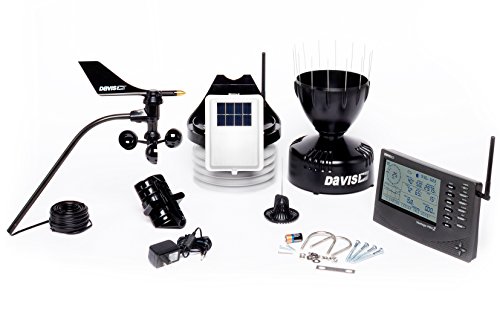
The Davis Vantage Pro2 features near-professional grade weather instruments in a package affordable to most consumers. You’ll get all the essential weather readings with the ability to add others like solar, UV and soil moisture sensors. The temperature and humidity sensors are enclosed in a radiation shield to keep it out of direct sunlight. You’ll also have the ability to upgrade to a model with a 24-hour fan-aspirated radiation shield for the most accurate temperature readings.
Runner Up: Davis Vantage Vue
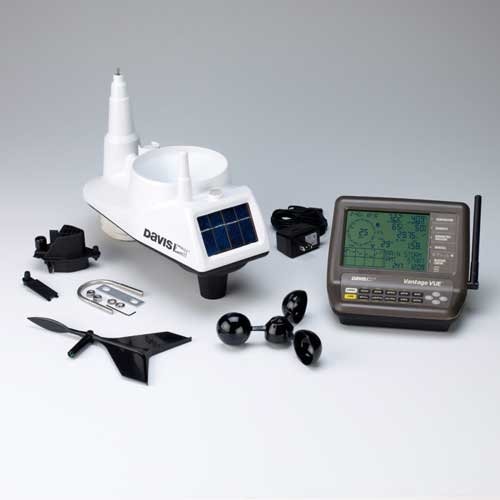
If you just can’t swing the Vantage Pro2’s higher price, then the Vantage Vue is our next-best Option. The Davis Vantage Vue can provide the weather data you need at home and one of the top pick weather stations for schools. Accuracy is close to the Vantage Pro2 although with less effective shielding your temperatures may skew a bit high on days with direct sunlight in the summer. The Vantage Vue is extremely easy to set up as it has an all-in-one sensor suite. Like the Pro2 you get all the basic weather readings, but on this particular model, you won’t be able to add additional sensors. Depending on what you need your weather readings for, that might make the Vantage Pro2 a better option.
Honorable Mention: Ambient Weather WS-1002-WIFI OBSERVER

Ambient Weather offers a lot of weather station models, and the WS-1002 is the company’s competitor to the Davis Vantage Vue. While we liked the WS-1002’s easy internet connectivity, accuracy is just not as good as either of Davis Instruments’ options. Construction of the station also appears to be a little less robust, so its usable life might end up being shorter. Still, you can’t beat the value here, and at the end of the day, the WS-1002 is a quality solar powered weather station.